

Difference Between Trust, Society & Section 8 Company – Which is Best for NGO in India?

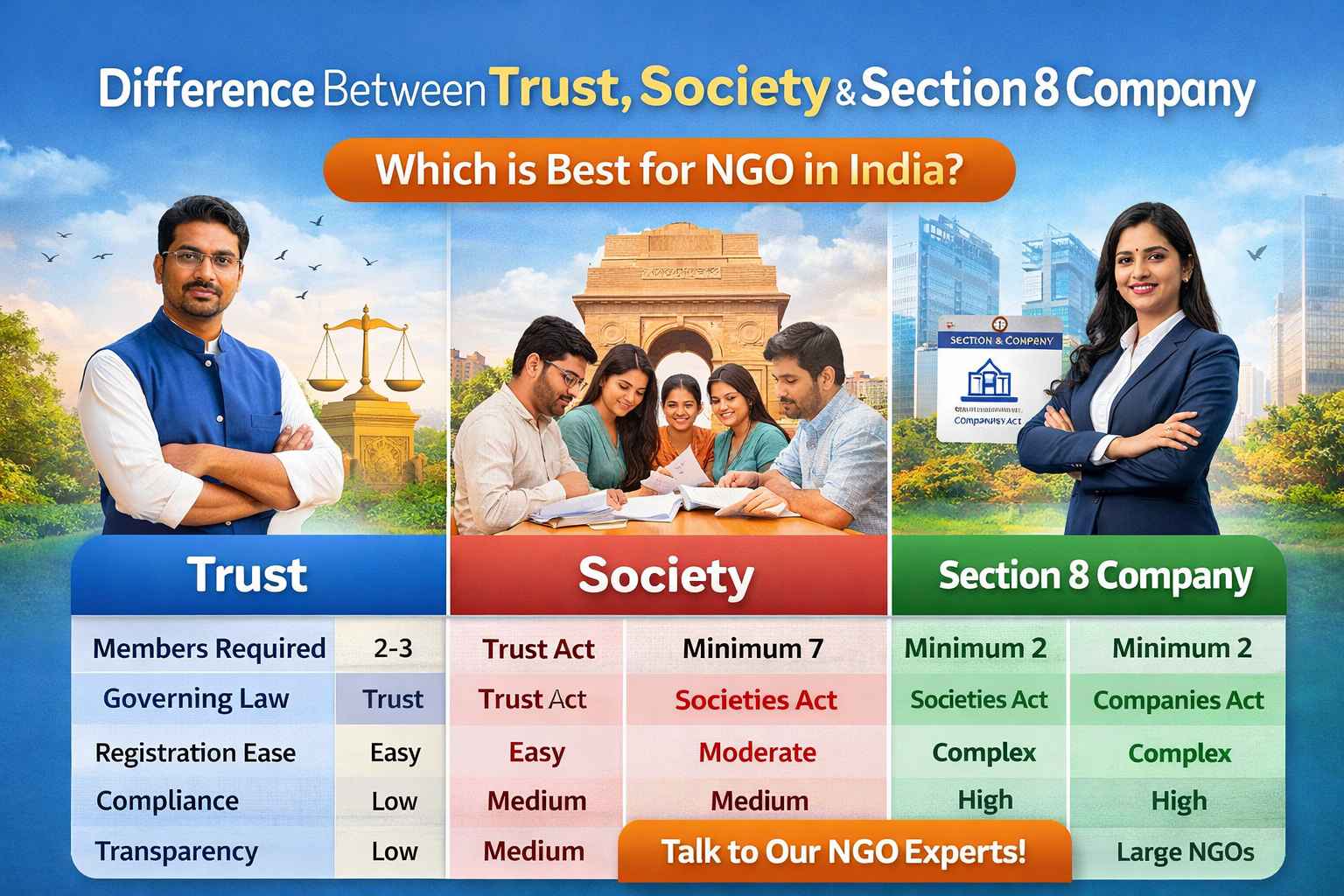
Difference Between Trust, Society & Section 8 Company – Which is Best for NGO in India?
Starting a Non-Governmental Organization (NGO) in India is one of the most effective ways to contribute to social welfare and bring positive change to society. Whether your goal is to work in education, healthcare, environment, or poverty eradication, setting up an NGO legally is the first and most important step.
In this guide, we will explain the complete NGO registration process in India, required documents, types of NGOs, and important compliance requirements in simple and easy language.
What is NGO Registration in India?
NGO registration is the legal process of forming a non-profit organization to work for social, charitable, educational, or environmental purposes. Registering your NGO provides legal recognition and allows you to apply for funding, tax benefits, and government schemes.
1. Trust Registration (Public Charitable Trust)
What is a Trust?
A Trust is one of the simplest ways to start an NGO in India. It is formed when a person (settlor) transfers property or assets to trustees for charitable purposes.
Key Features of Trust
- Minimum 1 Founder (Settlor) and 2 Trustees
- Governed by the Indian Trust Act (varies by state)
- Easy to form and manage
- Less compliance requirements
Advantages of Trust
- Quick and simple registration
- Ideal for small NGOs
- Less legal formalities
Disadvantages of Trust
- Limited transparency
- Less credibility compared to Section 8 Company
- Difficult to modify trust deed
👉 Best For:
Small NGOs, family-run organizations, and charitable activities at a local level.
2. Society Registration
What is a Society?
A Society is a group of individuals who come together to promote social, cultural, educational, or charitable objectives.
Key Features of Society
- Minimum 7 Members required
- Governed by the Societies Registration Act, 1860
- Democratic structure
- Suitable for group activities
Advantages of Society
- More transparent than Trust
- Suitable for large groups
- Flexible management
Disadvantages of Society
- More compliance than Trust
- State-level regulations may vary
- Slower decision-making
👉 Best For:
Community-based NGOs, associations, and organizations working in groups.
3. Section 8 Company Registration
What is a Section 8 Company?
A Section 8 Company is a non-profit organization registered under the Companies Act, 2013. It is formed to promote social welfare, education, environment, and other charitable objectives.
Key Features
- Minimum 2 Directors required
- Governed by Companies Act, 2013
- High level of transparency
- No minimum capital requirement
Advantages of Section 8 Company
- High credibility and trust
- Better chances of CSR funding
- Strong legal structure
- Separate legal identity
Disadvantages
- More compliance requirements
- Slightly higher cost
- Strict regulations
👉 Best For:
Professional NGOs, large organizations, and those seeking funding or corporate partnerships.
Difference Between Trust, Society & Section 8 Company (Comparison Table)
| Feature | Trust | Society | Section 8 Company |
|---|---|---|---|
| Members Required | 2-3 | Minimum 7 | Minimum 2 |
| Governing Law | Trust Act | Societies Act | Companies Act |
| Registration Ease | Easy | Moderate | Complex |
| Compliance | Low | Medium | High |
| Transparency | Low | Medium | High |
| Credibility | Medium | Good | Very High |
| Best For | Small NGOs | Group NGOs | Large NGOs |
Which is Best for NGO in India?
Choosing the right structure depends on your goals:
👉 Choose Trust if:
- You want a simple and quick setup
- You have a small team
- You want minimal compliance
👉 Choose Society if:
- You have multiple members
- You want democratic decision-making
- You plan community-level work
👉 Choose Section 8 Company if:
- You want high credibility
- You plan to apply for CSR funding
- You want structured and professional operations
Important Registrations After NGO Setup
No matter which structure you choose, you must apply for:
🔹 12AB Registration
Provides income tax exemption
🔹 80G Registration
Allows donors to claim tax benefits
🔹 FCRA Registration
Required for receiving foreign donations
Benefits of Choosing the Right NGO Structure
✔ Smooth legal operations
✔ Better funding opportunities
✔ Higher credibility
✔ Easier compliance management
✔ Long-term growth
❓ Frequently Asked Questions (FAQs)
Q1. Which NGO type is easiest to start?
Trust is the easiest and fastest to start.
Q2. Which NGO type has highest credibility?
Section 8 Company has the highest credibility.
Q3. Can I convert Trust into Section 8 Company?
Yes, but it requires proper legal procedure.
Q4. Is 12AB mandatory for all NGOs?
Yes, if you want income tax exemption.
Conclusion
Choosing between Trust, Society, and Section 8 Company is a crucial step in starting your NGO. Each structure has its own benefits and limitations. If your goal is simplicity, go for Trust. If you want teamwork, choose Society. And if you want credibility and funding, Section 8 Company is the best option.
Understanding these differences will help you make the right decision and build a successful NGO.
📞 Need Help Choosing the Right NGO Structure?
👉 Talk to Our Experts Today for NGO Registration & Legal Guidance
👉 Get complete support for Trust, Society, and Section 8 Company registration.
Start Your NGO Journey Today – Talk to an Expert!
We are ready to answer right now! Sign up for a consultation.
I consent to the processing of personal data and agree with the user agreement and privacy policy